Unlocking the strategic value of GIS in infrastructure construction
As infrastructure projects become more complex and expectations for predictability rise geographic information systems (GIS) emerge as a critical tool for construction leaders seeking greater control, clarity and efficiency. This blog post explores how GIS transforms project delivery by unifying design, field and real-world conditions into a single spatial system that enhances planning, safety, governance and collaboration. Through real examples from organizations like PCL Construction and Pomerleau, it illustrates how modern GIS investments streamline workflows, minimize risk and save customers significant time and costs, ultimately enabling more predictable, resilient and data-driven infrastructure projects.
As infrastructure projects grow larger, more complex and more interconnected, senior leaders are facing increasing pressure to deliver predictable outcomes despite uncertainty. Traditional reporting methods, fragmented systems and siloed data make it difficult to gain the real-time visibility needed to manage risk, control budgets and maintain schedule certainty.
Geographic information systems (GIS) have evolved from basic mapping tools into platforms that integrate building information modelling (BIM), drone imagery, IoT sensors and operational data into a single, spatially aware source of truth.
For executives, GIS is not simply a technical enhancement. It is an enabler of better governance, stronger collaboration, increased efficiency, improved safety and long-term operational intelligence. From this blog, you’ll discover how GIS can help resolve today’s toughest leadership challenges in infrastructure construction, how it powers smarter decisions and delivers measurable impact, through real-world examples.
The Challenge: Fragmented Data Creates Blind Spots
Leaders responsible for major capital projects consistently struggle with one overarching issue: a lack of clear, real-time visibility into site activity. Despite advances in delivery models, much of the information available to executives remains delayed, incomplete or disconnected. Weekly updates and static reports often fail to reflect rapidly changing site conditions or emerging risks.
On the ground, the complexity is immense. Crane locations must be continuously reassessed, lay-down yards compete with earthworks and temporary structures, and access routes shift as the build progresses. Without accurate spatial awareness, small conflicts can escalate into major delays. Even highly competent teams struggle to maintain alignment when working from different versions of the site reality.
Safety adds another layer of challenge. Traditional safety reporting is retroactive. By the time leaders hear about hazards or incident patterns, the opportunity for prevention has often passed. Emergency planning, security perimeters and restricted zones become harder to manage without a location-based understanding of site dynamics.
At the leadership level, executives must also navigate fragmented views of progress, quality and cost. Disparate systems make it difficult to understand how schedule slippage in one area affects downstream tasks or how recurring quality issues in specific zones contribute to risk and rework. Meanwhile, owners and operations teams require accurate, spatially organized data for handover, something construction teams frequently struggle to provide.
The solution: GIS Delivers True Project Clarity
GIS addresses these challenges by unifying design data, field information and real-world conditions into an integrated spatial system. Instead of presenting construction through siloed reports or disconnected applications, GIS gives leaders a real-time, geospatially accurate picture of the entire project.
This begins with site logistics. GIS pulls integrated drone imagery, surveys, BIM models and environmental data to visualize how the site evolves daily. This empowers teams to choose optimal crane placements, design efficient access routes, plan material flows and avoid conflict between temporary and permanent work. Leaders who leverage GIS no longer make decisions based on static drawings or intuition. They rely on live, visual evidence of the site.
For safety and security, GIS introduces a proactive approach. Hazards, near misses, equipment movement and environmental conditions can be monitored spatially in real time. GIS makes it possible to identify patterns of risk, understand high-incident areas and allocate resources before issues escalate. Emergency and security planning become significantly stronger when informed by accurate, location-based intelligence.
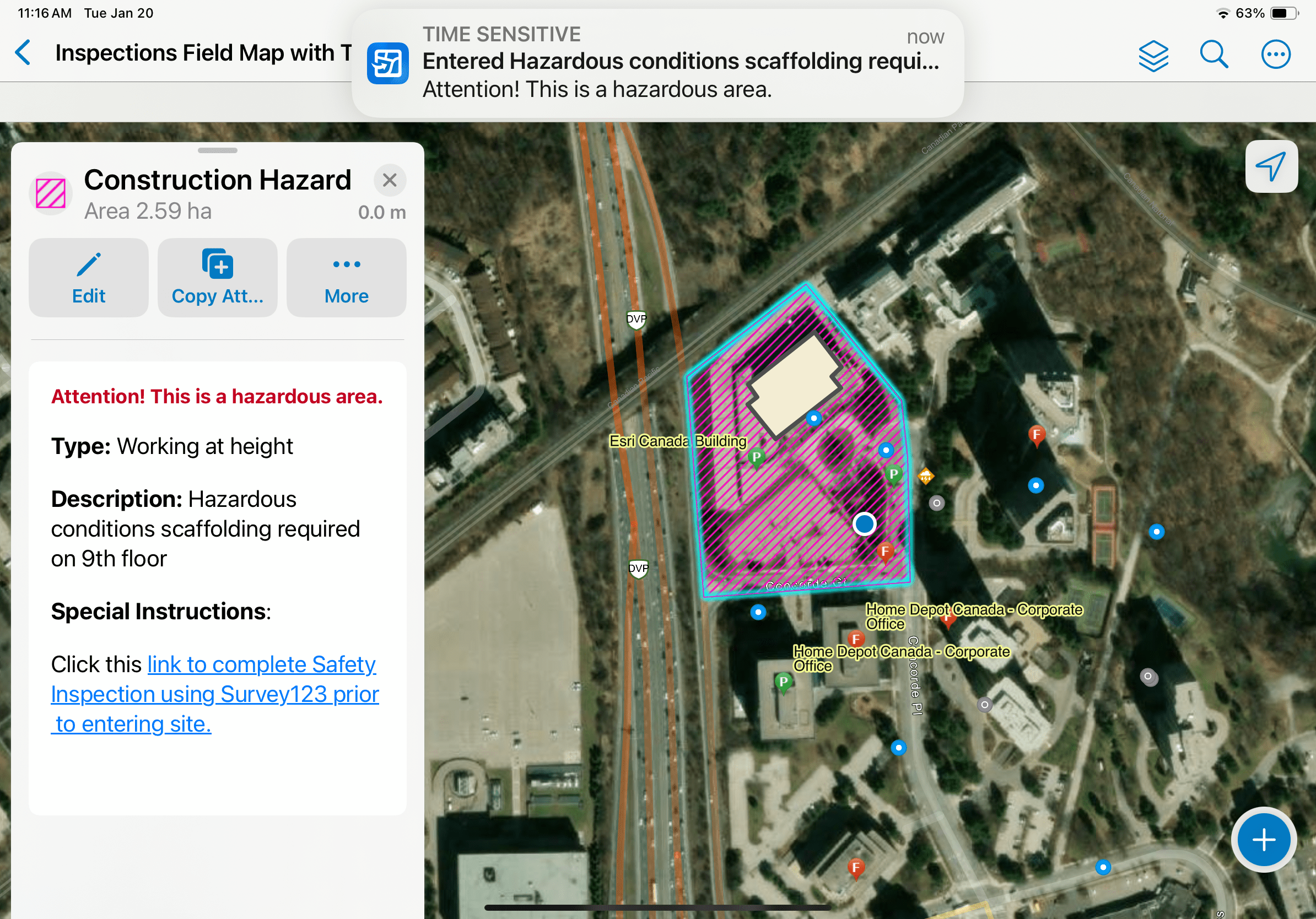
GIS also transforms project governance. Through dashboards that integrate schedule, quality and cost data, executives can see where work is advancing as planned, where delays are forming and why issues are occurring. Because the data is tied to specific locations, leaders can immediately understand context, something traditional spreadsheets and reports cannot provide. This visibility enables earlier intervention, better coordination across trades and more confident decision-making.
Finally, by integrating GIS with BIM, IoT sensors and construction management platforms, organizations create the foundation of a construction phase digital twin. This living model not only improves accuracy during delivery but also streamlines digital handover. Operations teams receive spatially structured data they can use from day one, reducing lifecycle costs and improving asset performance for years to come.
The Return on Investment: GIS as a Strategic Advantage
The return on investing in GIS is both operational and strategic. From an operational standpoint, GIS reduces rework, avoids conflicts, enhances planning and shortens timelines. When crane locations are optimized, haul routes are planned spatially and temporary works are coordinated with real-world conditions, productivity increases and delays diminish. These improvements quickly translate into measurable cost savings.
From a risk management perspective, GIS reduces safety incidents through real-time hazard awareness and improves security readiness through accurate spatial planning. This reduces insurance exposure, minimizes downtime and strengthens organizational resilience.
For executives, one of the greatest returns lies in predictability. GIS-powered dashboards and digital twins reduce uncertainty by making site conditions transparent. Leaders can act earlier, allocate resources precisely where needed and communicate with stakeholders using accurate, visually intuitive information. This strengthens trust across owners, partners and project teams.
Finally, GIS improves long-term value by ensuring high-quality data is carried into operations. Assets become easier to maintain, inspections become more efficient and lifecycle decisions become more strategic. A relatively modest investment in GIS during construction yields years of operational benefits.
Real-world examples of GIS in Action: Delivering Predictable and Efficient Projects
These benefits are currently being seen by-prominent organizations throughout Canada. For instance, both PCL Construction and Pomerleau utilize GIS technology during the construction phases of significant infrastructure projects.
PCL Construction, a leading general contracting firm in North America recognized for its major project delivery, implemented GIS, drones and BIM integration at Vancouver’s New St. Paul’s Hospital to proactively detect site conflicts and streamline complex tasks such as large-scale concrete pours. This approach enhanced cost predictability throughout the project lifecycle. The-team leveraged an extensive range of digital technologies, including BIM, drones, IoT and immersive visualization, all aimed at reinforcing patient care through data-driven infrastructure.
These advanced solutions enabled the project team to-optimize-design coordination, strengthen safety measures and facilitate real-time decision-making, resulting in measurable improvements such as:
- Streamlined workflows
- Reduced rework
- Minimized risk
- Faster collaboration
Investments in GIS technology have also-provided PCL the ability to identify spatial conflicts earlier, accelerate planning cycles and provide clearer location-based insights that save significant time and cost throughout the construction process.
Vancouver’s New St. Paul’s Hospital project, valued at $1.7 billion, comprises over 5,500 rooms constructed with sustainable methods, precise execution-and advanced operational management. By prioritizing environmentally responsible practices and leveraging innovative construction strategies, the development aims to minimize its ecological footprint while maintaining high standards for quality and functionality. Collaboration among multiple partners was central to delivery, with these efforts earning recognition at the 2025 Building Transformations event, where the team received the Collaboration Award. This prestigious honor highlights the project's exemplary teamwork and the effective use of technology to overcome challenges in modern healthcare construction.
On a separate construction initiative led by Pomerleau, one of Canada's largest builders with revenues nearing $6 billion, Esri technology was used to collect data from IoT sensors attached to slip forms. These sensors tracked crucial information such as location, orientation, elevation and the temperature of the concrete, allowing for ongoing monitoring of structural quality and precise control over the concrete-curing process.
The-Ciment Québec project, featuring an advanced grinding plant, will enable the production of low-carbon cements like limestone cement and is expected to reduce the facility’s carbon emissions by 10%. BIM modelling supported highly accurate slipform planning; each element was modelled in 3D to help the construction team foresee and address potential challenges. Additionally, Pomerleau introduced new software that let the team track the elevation, vertical alignment and pouring rate, making it possible to forecast appropriate curing times.
To ensure complete alignment across teams, Pomerleau integrated BIM representations of the new centre with location-based data using Esri’s ArcGIS technology. This resulted in a dynamic digital twin of the construction site, offering centimetre-level spatial accuracy and real-time insight into project status. Key details were instantly shared with on-site staff via mobile apps, supporting the correct placement of steel plates and openings and helping maintain the schedule.
For these achievements, Pomerleau earned the Esri Special Achievement in GIS (SAG) Award for its innovative application of GIS and IoT sensors during this major construction project. By merging live sensor readings with BIM and GIS dashboards, Pomerleau was able to speed up critical phases of the build by up to 33% while also enhancing both quality control and situational awareness.
Together, these examples illustrate that GIS is not just a technical upgrade. It’s a strategic capability that enables organizations to deliver more predictable, more efficient and more resilient infrastructure projects.
Explore More
Dive deeper into the innovations, partnerships, and digital construction strategies shaping this project:
Building Transformations Awards: PCL Construction – New St. Paul’s Hospital: Discover how this landmark project is redefining healthcare infrastructure.
PCL Insight: Drone Data Enhancing Budget and Quality-: See how advanced drone data collection is improving accuracy, efficiency, and decision making.
Esri Canada: Construction Phase Digital Twin: Explore how a digital twin reduced risk and increased precision throughout construction.