Pomerleau’s Digital Construction Hub: Making location the heart of project control
Pomerleau’s Digital Construction Hub utilizes ArcGIS to bring BIM models, drone imagery, schedules, and field data together in a single digital environment. This approach enables teams to know not only what is happening on major projects, but also where it is happening. Here is how they did it.
The challenge
Construction projects generate enormous volumes of information coming from planning, design, quality, project control, environment, and health and safety. This data is traditionally spread across several systems and managed by different teams.
Without a single source of truth, simple questions become hard to answer:
- What is slowing us down, and where?
- Where will crews need to share space?
- What are the main risks on site?
To find clear answers, project stakeholders have to check a schedule in one tool, a 3D model in another, and field reports somewhere else. As a result, decisions can take longer than they should.
Why it matters
Canada is facing an infrastructure crisis. An estimated 11% of public infrastructure across the country is in poor condition while nearly half of assets are in need of repair in some provinces. On top of this significant maintenance shortfall, new infrastructure projects in Canada frequently take longer than expected and tend to cost more than similar projects in other countries. Transit is one visible example: Canada ranks 9th highest out of 60 countries for construction costs, at an average of $377M per kilometer.
Digitizing construction is one way for the industry to change course and increase productivity, especially as experienced workers retire faster than they can be replaced.
About Pomerleau
Pomerleau is one of Canada's three largest construction companies, with approximately $6.1 billion in revenues in 2025. Founded almost 60 years ago, the family-owned business has over 5,000 employees and workers involved in over 200 active projects from coast to coast.
Pomerleau currently works on some of the most ambitious infrastructure projects in the country. Several appear on the 2026 ReNew Canada Top100 list, including the Blue Line Project in Montreal (#10), the Surrey Langley SkyTrain in Vancouver (#15), and the WAHA hospital network redevelopment in Ontario (#50).
The solution
With the Digital Construction Hub, location becomes the heart of project control. Pomerleau already organizes its projects by work breakdown structure (WBS) which is what needs to be done. The Hub links that structure to a location breakdown structure (LBS) which is where the work needs to happen on site. ArcGIS ties the two together, giving project stakeholders a shared geographically contextualized view of the project.
The result is a single source of truth, powered by Esri.
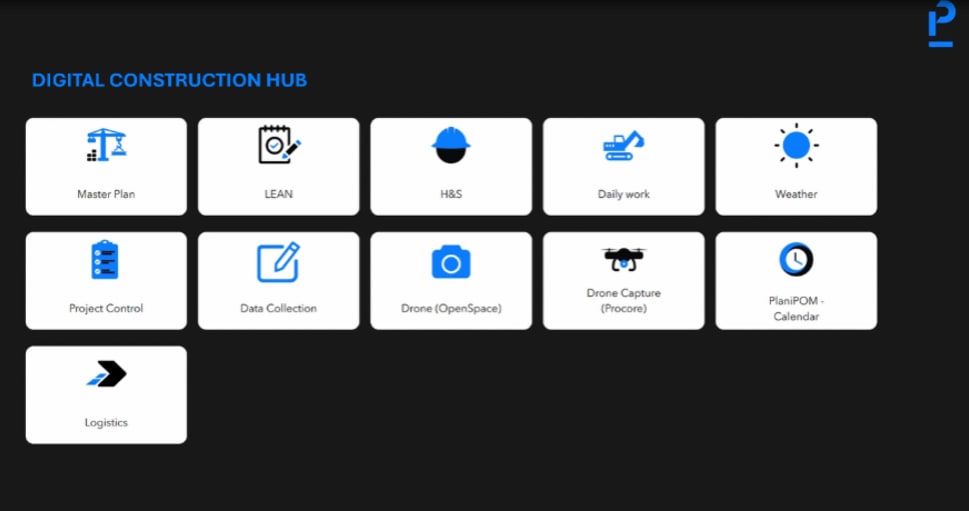
Each tab of the Hub takes users straight to the information they need.
How it’s built
The Digital Construction Hub brings together four main types of data in ArcGIS.
BIM models
Pomerleau hosts georeferenced 3D BIM models in Forma, Autodesk’s cloud-based environment. From there, the models are connected to ArcGIS and integrated into the Digital Construction Hub.
Field-captured data
Using ArcGIS Survey123 forms, field teams can click directly on specific components in the 3D model and send information to the Digital Construction Hub. Crews use laptops in site trailers, tablets, and mobile phones to visualize the model and record data such as completion status, installation dates, and concrete volumes poured.
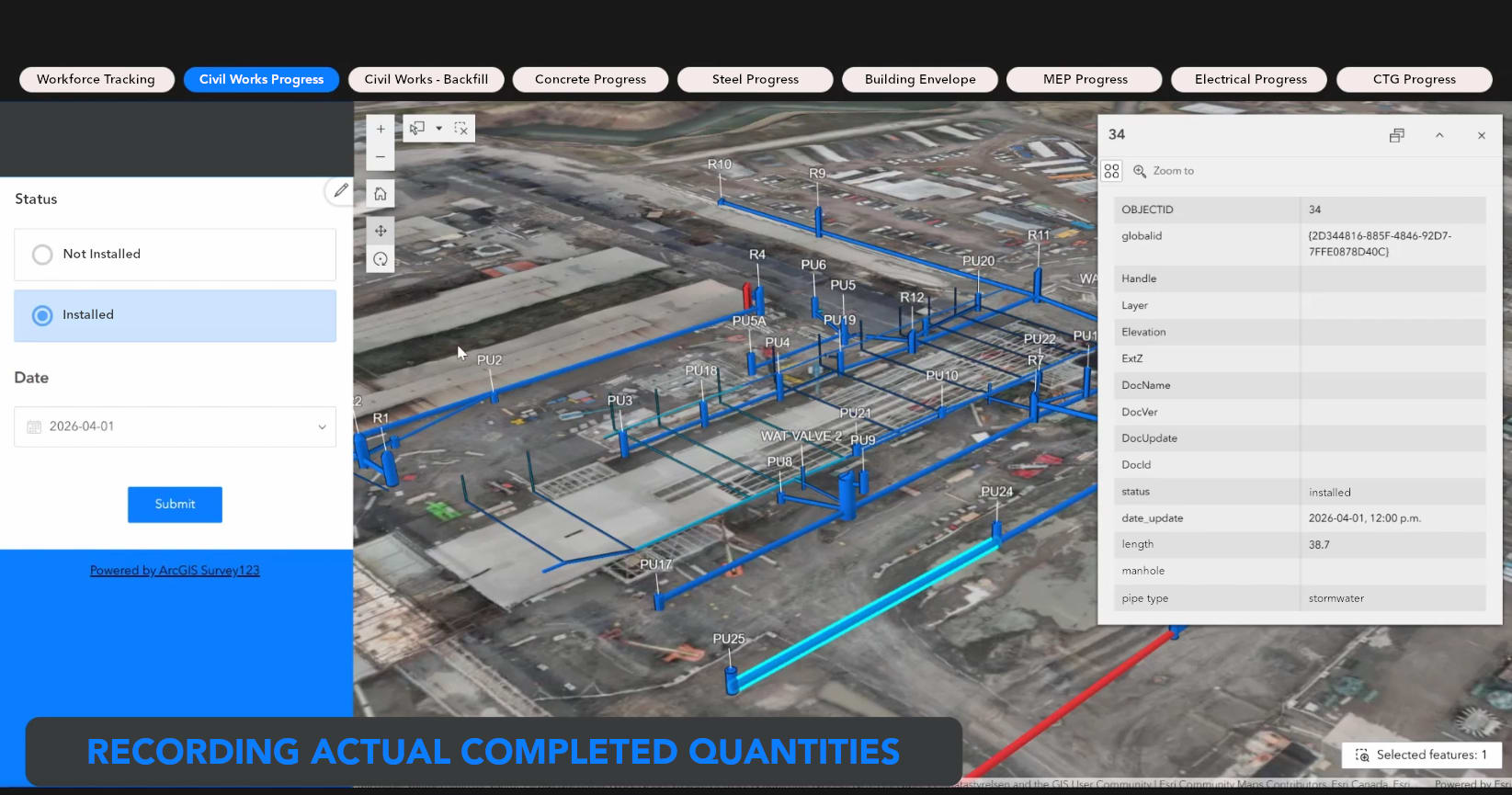
Field teams update the status of drainage pipes as installation progresses.
Drone imagery
Weekly drone flights provide a realistic view of site conditions.
Schedules
Schedules from Primavera P6 or Procore show when work is planned. Pomerleau's in-house tool, PlaniPom, enables teams to reserve specific work zones for construction activities.
The data interface: ArcGIS Experience Builder
A 3D ArcGIS scene, embedded in a web application through ArcGIS Experience Builder, brings all of the Digital Construction Hub data together in a single environment accessible from any browser.
Field teams collect the data, office teams organize it, and project stakeholders query it.
The Benefits
1. Improve Visibility Into Project Progress
On a construction site, the first question is often: how far along are we? The Digital Construction Hub gives each discipline its own progress view. As work advances, field teams update the status of specific components. From there, the work done is compared to the work planned and progress metrics are displayed.
Each component of the 3D model is automatically color-coded by completion status, enabling office teams to understand at a glance which areas are complete and where work is still underway. Sharing one view reduces back-and-forth between office and field teams and creates a clearer reporting experience for project stakeholders.
One source of data, one source of information. Pomerleau’s [Digital Construction Hub] is one of the tools I use the most to visualize progress on site.
— Project director, industrial sector
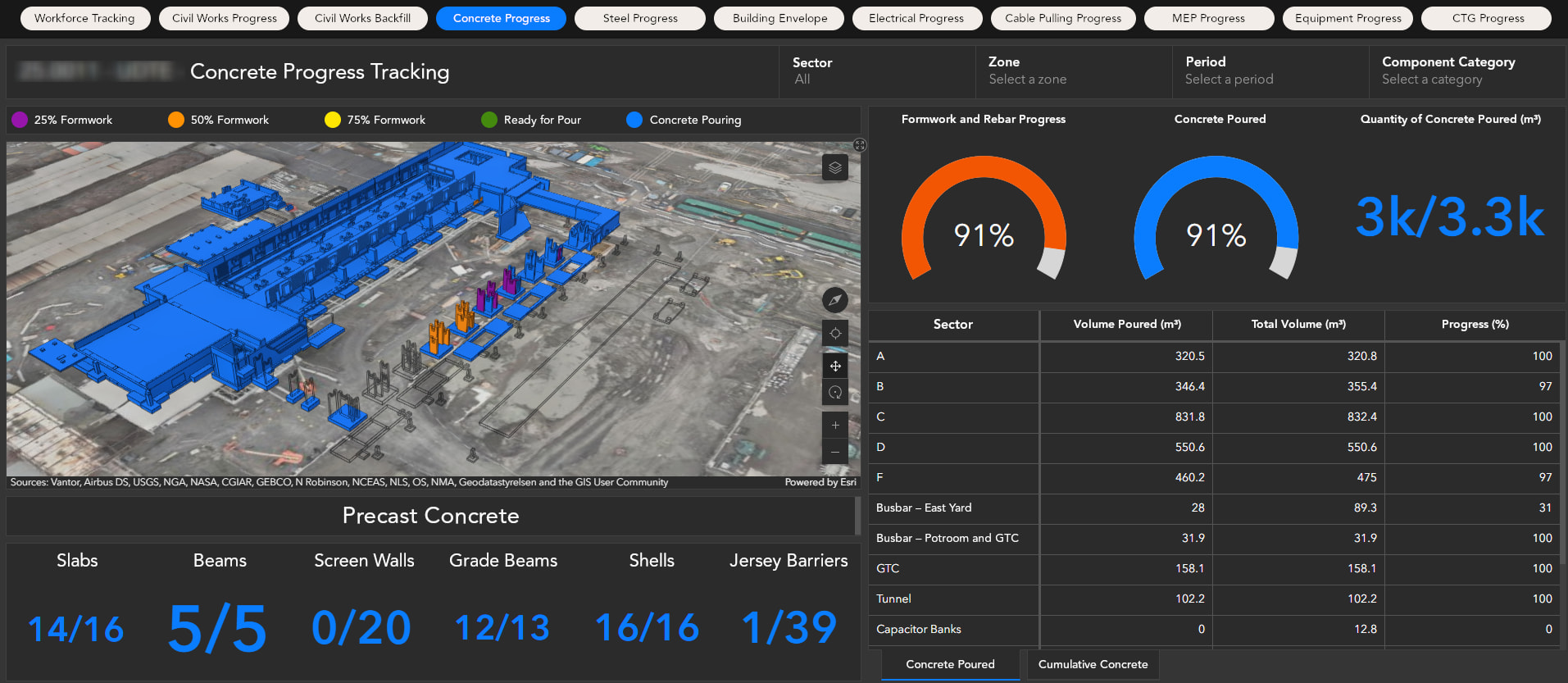
Concrete elements change color on the 3D model as they move from each stage (formwork, rebar, pour).
2. Streamline Coordination Across Shared Work Zones
Using PlaniPom, contractors reserve the work areas they need on site ahead of time. Their bookings appear in the Digital Construction Hub overlaid on drone imagery.
Areas reserved by multiple contractors are flagged as shared zones, enabling superintendents to visualize and coordinate overlapping activities before work begins. The result is a smoother and more predictable workday.
Daily planning used to happen around a whiteboard in the site trailer with three columns: yesterday, today, and tomorrow. The Digital Construction Hub adds a spatial layer to that process. Teams can now see where work is planned and where crews will share space as they plan the day ahead.
— Anthony Le Guen, VDC Manager at Pomerleau
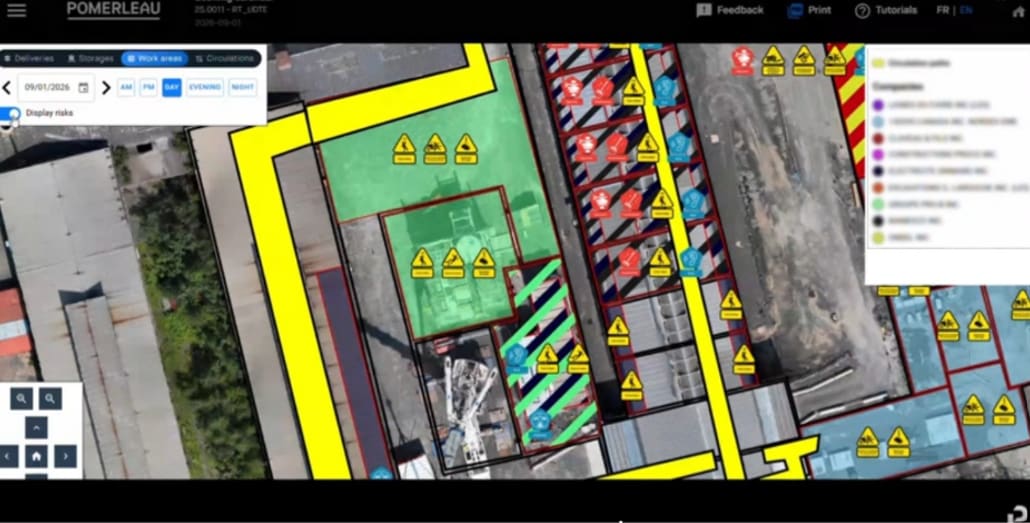
Crosshatched areas show work zones shared by more than one contractor. Symbols indicate safety risks.
3. Strengthen Site Safety Through Better Reporting and Visibility
Safety comes first in construction. The Digital Construction Hub offers dashboards where managers can consult key metrics such as worker counts, hazards, near misses and accidents. A weather component adds context about potential risks from extreme weather events and poor air quality.
Because each issue is located on the site, health and safety teams can quickly see where risks and constraints are concentrated. A calendar view of reported events also helps teams spot periods of higher risk and implement appropriate mitigation measures.
Week on week, are we improving? The Digital Construction Hub is really helpful to track our team’s health and safety performance on site.
— Project director, industrial sector
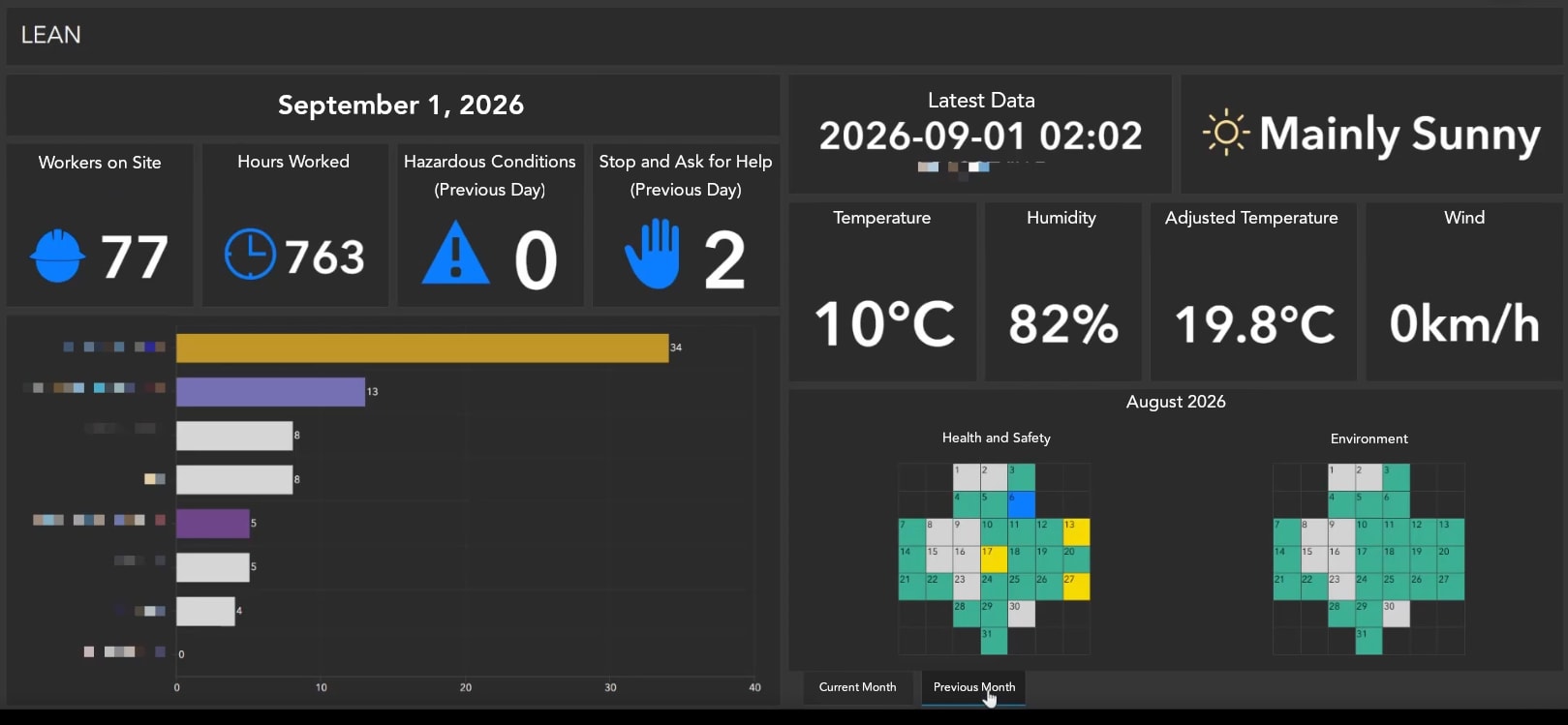
Safety dashboards track hazards, near misses and incidents over time.
Where next?
Known for its commitment to innovation, Pomerleau has been combining GIS and BIM on its projects for several years. In 2025, the firm received an Esri Special Achievement in GIS Award for integrating GIS, BIM and IoT for a concrete-crushing center project.
The Digital Construction Hub builds on that foundation.
“In the future, I’d like to integrate artificial intelligence into the Digital Construction Hub so users can ask questions and get answers based on all the information captured throughout the project. If an area is behind schedule, is it because of a safety incident? Did a contractor not show up? Are we waiting on a delivery? AI could then make predictions and suggest ways to make up for delays.
At the end of a project, the digital handover requirements are often limited to a set of as-built files. We’re ready to go much further and provide owners with a digital twin they could continue using to operate their asset.”
— Anthony Le Guen, VDC Manager at Pomerleau
The difference it makes
The first deployment of the Digital Construction Hub supported approximately 176 users. Across just two measured workflows, the Hub freed up approximately 624 skilled hours, a conservative annual value of $80,400. Building on that success, Pomerleau is now implementing the Digital Construction Hub on 4 additional projects.
For AEC firms like Pomerleau, the value of a well-integrated digital approach goes beyond dollars. Every hour freed from chasing scattered information is an hour that can go toward building the hospitals, schools, transit systems and industrial facilities that we all depend on.
Sources
- News: New coalition launches to champion Canada's infrastructure economy
- Plan québécois des infrastructures 2026–2036 (in French)
- FAO Ontario – Municipal Infrastructure: A Review of Ontario's Municipal Infrastructure (2021)
- Understanding the Drivers of Transit Construction Costs in Canada — U of T School of Cities
- LMI 2026-2035 - BuildForce Canada